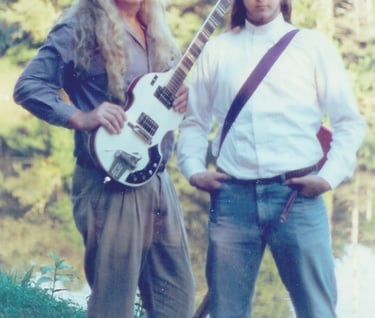
The Beginning
1971–1978
John Crafton began performing as a solo artist in 1971, often joined by a changing group of accomplished musicians while working in Europe.
After approximately a year and a half overseas, he returned to the United States and continued writing, performing and developing the body of music that would eventually become Fable.
For John, the songs were never simply accounts of events. A story might be true, partly true or entirely imagined, but it needed to have something meaningful to say.
Over the following years, the music grew more ambitious. It still carried the energy of John’s earlier rock years, but the arrangements began expanding around the stories.
By 1979, after nearly two years devoted heavily to writing and arranging, John began assembling the musicians who could bring the project fully to life.
Fable and In the City
1979–1984
The first major incarnation of Fable grew directly out of the life John was living at the time.
The songs recognized and acknowledged his circumstances, the people around him and the direction his life had taken. Some were drawn closely from experience. Others used characters and storytelling to reach a larger truth.
The group was far from conventional. At its largest, the ensemble included as many as sixteen musicians. Over the course of the project, John worked with numerous players, including musicians associated with the Baltimore Symphony.
The arrangements combined rock and roll with horns, strings and large ensemble performances, following the songs wherever they needed to go.
John’s brother, Richard Crafton, became an important collaborator during the creation of the project that would eventually be known as In the City.
While John and Richard pursued recording opportunities in the early 1980s, the music was described in the industry trades as Broadway rock and roll. The phrase reflected the size of the arrangements and the way the songs were brought together within a larger idea.
The album was completed in 1984, and serious contract negotiations were underway.
Then life changed suddenly.
John and Richard both went through divorces, and both became the custodial parents of their children. Signing a contract and committing to extended touring was no longer practical.
They chose to raise their children, and the band was disbanded that same year.
In the City was never commercially released.
The recordings, however, survived.
From the Archives
John is making several recordings from this period available as a free offering from a bygone era:
In the City
Full Tilt Boogie
Song for Joey
These songs preserve one of the most ambitious periods in Fable’s history and offer a glimpse of what John and Richard created more than four decades ago.
[INSERT MUSIC PLAYERS AND DOWNLOADS]
A New American Folk Group
The 1990s
When John reestablished Fable, he did not want to repeat what the band had already done.
There was nothing wrong with the rock and roll or the larger arrangements, but John wanted to explore something different. The new group moved toward acoustic instruments, vocal harmony and songs that could stand closer to the listener.
They called it New American Folk.
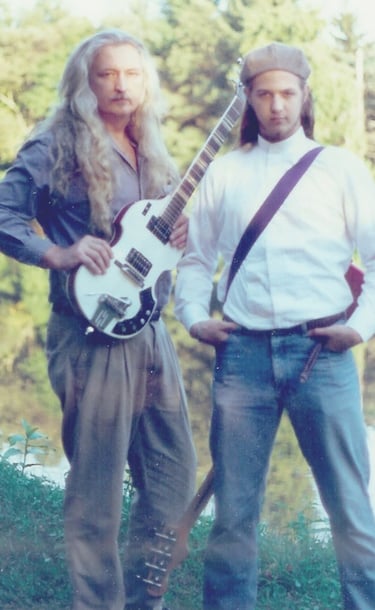
John Crafton, John Crafton III and Anthony Gavoli formed the foundation of this new version of Fable and recorded Pipe Thoughts & Tea, the first compact disc released under the Fable name.
The group performed in theaters and concert settings throughout New England and completed a regional tour in support of the album.
By 1998, the lineup included John Crafton Jr. on six and twelve string guitars, banjo and vocals; JQ Crafton on vocals; Anthony Gavoli on bass and vocals; Joshua Willis on percussion and vocals; and John Spreier on six and twelve string guitars and vocals.
Every member contributed vocally, allowing the group to create powerful five part harmonies around John’s songs.
A surviving performance of “One by One” at the Odeum Theatre in Warwick, Rhode Island captures that version of Fable in its element: acoustic instruments, several distinct voices and a song with something to say.
Watch “One by One”
[EMBED VIDEO HERE]
Listen to Pipe Thoughts & Tea
[INSERT ALBUM PLAYER OR SONG SELECTIONS HERE]
Over time, the musicians moved into new chapters of their own lives. John, his youngest son Richard and John’s wife Christine eventually relocated to Akron, Ohio.
Another version of Fable was about to begin.
Storybook
Akron, Ohio — 2005
Fable came together again in Akron for a particular purpose.
John and a new group of musicians were preparing an album for the Kent folk festival. The lineup included Samuel Salsbury on violin, Lisa Blayney on vocals, Tom Schurr on bass, Keith Bachman on guitar, and John on lead and harmony vocals, banjo, guitar and keyboards.
Together, they created Storybook.
The title returned to the original principle behind Fable. These were songs built around stories, characters and messages.
The physical CD was accompanied by an illustrated book containing the lyrics to every song, allowing listeners to read the stories while hearing them performed.
Among the songs was “Grandfather’s Home,” written in connection with the possibility of its use for a proposed prime time network talk show.
The band spent the following months performing and promoting the album. Its final appearance took place at the Kent Stage in Kent, Ohio, during the 2005 folk festival for which the album had been created.
For a brief season, Fable had once again become a living band rather than a collection of recordings and memories.
Explore Storybook
[INSERT BAND PHOTOGRAPH]
[INSERT STORYBOOK COVER AND INTERIOR PAGES]
[INSERT ALBUM PLAYER]
Weathered
Spokane, Washington — 2007
In 2007, John and Christine moved to Spokane, Washington, where John began working with Gary Burris in another effort to rebuild Fable.
This time, the music developed differently.
Rather than forming around one permanent lineup, Weathered grew through collaborations with different musicians over time. John performed much of the instrumental work himself and brought in additional players when a song needed a part or texture he could not provide alone.
Those separate performances and sessions were gradually brought together and shaped into the completed album.
The title was appropriate.
By then, Fable had lived through several incarnations, crossed thousands of miles and survived changes that might have ended another musical project permanently.
The album included “Ghost” and other songs that continued Fable’s tradition of using stories to reach something deeper than the events being described.
Approximately six months after arriving in Spokane, John returned to Akron to reunite with his son Richard. At about the same time, the completed recordings were submitted for CD production.
Weathered went on to receive encouraging critical attention and became another lasting chapter in the Fable catalogue.
Listen to Weathered
[INSERT ALBUM PLAYER]
[INSERT ORIGINAL REVIEW OR PRESS EXCERPTS]
[INSERT ALBUM ARTWORK AND RECORDING PHOTOGRAPHS]
Why Fable Kept Returning
John never ran out of songs.
He continued writing wherever he lived, and when he played the new material for audiences, people encouraged him to record it.
That encouragement mattered because John did not write simply to collect songs in a notebook.
He wanted to share them.
Each return of Fable gave those songs a group of voices, a set of instruments and a way to reach listeners. The band did not need to sound exactly as it had before. It only needed to serve the songs John was writing at that point in his life.
That is why Fable could move from rock and roll to New American Folk, from a large ensemble to a five voice acoustic group, and later to albums created through changing groups of collaborators.
The sound could change because the purpose remained the same.
From Washington to California
Following the creation of Weathered, John spent approximately three years living and working on a horse rescue farm located on a Native American reservation near Springdale, Washington.
After leaving the farm, he moved to Los Angeles and returned to performing as a solo artist. He played clubs and engagements throughout the region while continuing to write new material.
But the West Coast never truly felt like home.
John had lived among Washington evergreens and California palm trees, and he found himself missing the hardwood forests of the East.
He wanted maples and oaks.
More than anything, he wanted to get back to his roots.
An Accidental Road to Greeneville
John began driving east with the intention of purchasing a property near Boone, North Carolina.
Before he could complete the purchase, the property was sold.
John had brought a great deal of equipment and belongings across the country and needed somewhere to put everything. That practical problem led him to purchase a property in Greeneville, Tennessee.
He did not arrive with a carefully prepared plan to establish a music venue.
He landed in Greeneville almost by accident.
But being who he was, John naturally needed a place to produce music and entertainment. He began looking at the property not only as somewhere to live and store his equipment, but as somewhere music could happen.
Alongside his life as a songwriter and performer, John had built a successful career as a builder and real estate investor. In Greeneville, those skills gave him the ability to do more than reorganize another band.
He could create a home for the music.
A Home for Music in Greeneville
John and his son Richard established a recording studio and created Wire & Wood Acoustic Coffeehouse and Listening Room.
The goal was to build a welcoming place where John could continue producing music while helping other artists establish themselves.
It needed to be a room that respected the performer, connected with the community and gave audiences a place where they could truly listen.
Wire & Wood became a family friendly listening room where local, regional and national artists could perform, be heard and begin building their audiences.
The venue also became a gathering place for musicians, listeners and members of the Greeneville community.
Performances and featured artists could reach beyond the room through Folkrider Radio, John’s longtime internet radio station devoted to independent music.
What began as an unexpected stop became home.
Tennessee felt familiar to John. Greeneville offered the hardwood trees he had missed, but it also gave him a community where the different parts of his life could finally come together: songwriting, recording, construction, radio, performance and the desire to help other musicians be heard.
Friends Along the Way
No history of Fable could be complete without recognizing the musicians, friends, collaborators and family members who contributed to the journey.
Some stayed for an album. Some joined for a performance, a tour, a season or a single recording session.
Each brought something of their own to the music.
Each left something behind.
[INSERT “FRIENDS OVER TIME” VIDEO]
The Music of Fable
In the City
[ALBUM ARTWORK]
[SONG PLAYER AND FREE DOWNLOADS]
Pipe Thoughts & Tea
[ALBUM ARTWORK]
[SONG PLAYER]
Storybook
[ALBUM ARTWORK]
[SONG PLAYER]
[STORYBOOK GALLERY]
Weathered
[ALBUM ARTWORK]
[SONG PLAYER]
[PRESS AND REVIEWS]
The Future of Fable
Now, at 76, John continues to write, perform and share music.
The newest version of Fable is taking shape at Wire & Wood, the venue John and Richard created in the community John found by accident and came to love.
It is not an attempt to recreate one particular lineup from the past. It is the continuation of an idea that has survived every change of personnel, geography and circumstance.
For John, rebuilding Fable has always been about having more songs to share and finding the musicians who can help bring them to life.
The new group is preparing to enter the studio in the fall, with plans to record two new albums.
As John says:
“It’s fun keeping our hand in at the coffeehouse as we build the new band Fable. There’s more to come, so watch for it.”
He calls it attempt number four.
But Fable has never really been a series of failed attempts. It has been one long story, interrupted by family, distance, responsibility, changing musicians and the ordinary turns of a full life.
Each time, John picked up the songs and began again.
And this time, Fable already has a home.
Fable began with a simple idea:
"A song should tell a story, and that story should leave something behind."
It did not have to be completely factual. The characters and circumstances could be remembered, imagined, borrowed or reshaped. What mattered was that the song carried a message, made an impact and gave the listener something to think about after the music ended.
That idea has followed John Crafton through every version of Fable.
Fable has never been only one band, one collection of musicians or one moment in time. It has been a continuing musical idea, reshaped across decades by the people, places and experiences that entered John’s life.
The musicians changed. The sound changed. Life interrupted the journey more than once.
John kept writing, and Fable kept returning.
THE FABLE LEGACY
Anthology
More Than Forty Years of Music, Reinvention and Storytelling
john@johncraftonmusic.com
John Crafton Music